|
|
|
 |







|
|
|
| APUSH Review Sheet and AP US History Cram APUSH Flashcards and online review packet and study guide for AP ® United States History, and the SAT Subject Test US History ™ . Key Terms To
Know (All Flashcards here) (SCROLL TO BOTTOM FOR REVIEW SONGS / VIDEOS) Period 1, 1491-1607 (5% of Exam) and Period 2, 1607-1754
Period 3, 1754-1800
HamiltonHamiltonHamiltonHamiltonHamiltonHamiltonHamiltonHamilton
Period 4, 1800-1848
Period 5, 1844-1877
Period 6, 1865-1898
Period 7, 1890-1945
Roosevelt Corollary,
Big Stick Diplomacy,
Panama Canal, Teller and Platt Amendments,
Open Door Policy / John Hay,
Populism,
Moral Diplomacy,
Cross of Gold Speech,
The Jungle,
Muckrakers,
Conservation,
/span>
Ballinger-Pinchot,
John Muir,
Triangle Fire,
Settlement Houses,
Election of 1912,
Clayton
Antitrust Act,
Underwood Tariff,
FTC,
Lusitania,
Zimmermann Note,
Red Scare,
Lost Generation,
Flapper,
Sacco and Vanzetti,
Mother's
pensions,
Great Migration,
Harlem Renaissance,
Teapot Dome,
Scopes Trial,
Dust Bowl, Bonus Army,
Reconstruction Finance Corporation
and Smoot-Hawley Tariff,
Fireside Chats, Relief Recovery Reform,
John Maynard Keynes,
Bank Holiday,
AAA,
FDIC,
SEC,
CCC, WPA, PWA, TVA,
,
NIRA and NRA,
Social Security,
Court Pack,
Huey Long,
Lend-Lease Act,
Period 8, 1945-1980; Period 9, 1980-Present (5% of the Exam)
Click here for APUSH Flashcards 1491-Present
Continuity and Change Examples
NEW!!! APUSH Review in 18 Minutes! Brace yourself.
MAJOR CONCEPTS
IN US HISTORY What do I need to know about Native America and early Spanish Settlements? What role did religion play in the colonies?
What were the major events of the American Revolution? Also know the French and Indian War. What were the weaknesses of the Articles of Confederation? What were the major Compromises of the Constitution? Why did America want Independence? What did the Declaration of Independence actually say?
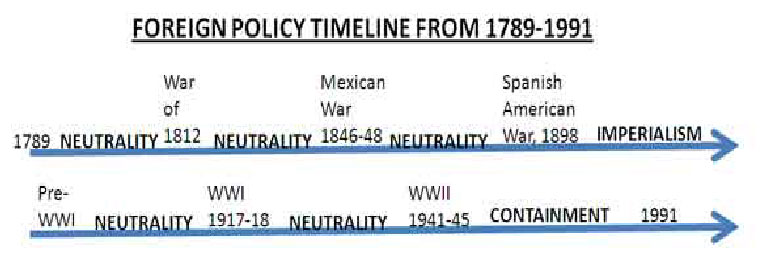
How do the branches of government check one another? What was Washington’s stance on foreign policy? What were the major events of the War of 1812? The Most Important Battle? What were the major issues under "Jacksonian Democracy." Hint: Tariff, Bank, Nominating Conventions, Spoils System, Trail of Tears, Specie Circular, Ordinance of Nullification, Force Bill. (Perhaps that was more than a hint.) What should I know about the market revolution of the early-middle nineteenth century? How did America expand during manifest destiny?
What were the causes of the Civil War? What part did slavery play in it? Know your compromises! (see below) You may want to know about certain ... important ... Civil War ... Battles, and facts. How did the United States deal with Native Americans from colonial days to the Gilded Age? How did women affect social movements? Westward Expansion -- Know the Turner Thesis, Homestead Act, and the plight of Native Americans during manifest destiny. What were the two Great Waves of immigration? What quota laws, and recent laws about immigration should I know? What happened during the Gilded Age concerning "Robber Barons" and industrialization? What were some of the cultural innovations of the Roaring 20s? Sports, Music, etc.? Why did immigrants move towards cities? How did the cities emerge? How did Populists influence the Progressives? What were the Progressive Reforms? How did American foreign policy change c1898? One answer is this, which resulted in this. Upton Sinclair ... and ... All of the other Progressive Reformers you need to know. What was the controversy over the Treaty of Versailles Ratification? Rachel Carlson's Silent Spring comes up all the time. It's a book about environmentalism. Why was it called the Roaring 20s? What were the causes of the Great Depression, and the solutions implicated by the New Deal (RRR)?
What were the major clashes of the Cold War? How did different generations of Americans clash during the 60s and 70s? How did segregation come to an end? What impact did the Warren Court have? Know all about the Civil Rights Leaders of all Eras, and the importance of Dr. Martin Luther King Jr. What's the deal with Federalist #10? How has the US been involved in the global economy? Don't get confused: W.E.B. Du Bois wanted absolute equality...Booker T. Washington wanted gradual gains. Remember: W.E.B. = Wants Equality for Blacks...Booker T., for Tuskegee Institute.
Click here for APUSH Flashcards 1491-Present
THE LONG ESSAY (click for in-depth look) The DBQ Essay (click for in-depth look) YOU WILL BE ASKED A QUESTION RELEVANT TO THE NEW APUSH HISTORY REASONING SKILLS
Continuity and Change Examples
In the Long Essay, there's a good chance you will be asked to support, modify, or refute a statement ... such as, "Some historians believe that the New Deal did not help out the economy during the Great Depression. Support, modify, or refute the above statement." See links above.
LONG ESSAY TIP: BE PREPARED TO WRITE ABOUT SOCIAL HISTORY. That Means: Race, Gender, Religion, and Culture questions ... the essay will look to show continuity and change over time ... look to study:
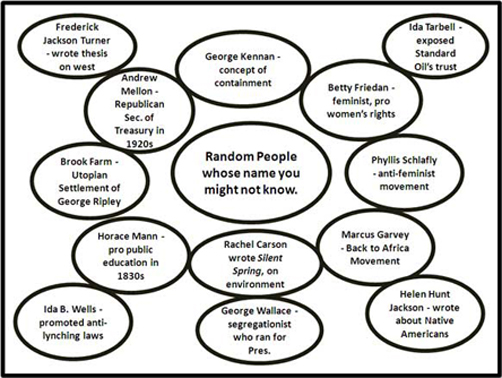
1. POPULISM --> PROGRESSIVISM --> NEW DEAL (TRACE THE LIBERAL REFORM MOVEMENTS) Omaha Platform = STAR 16 (Senators, Tax, Australian Ballot, RR control) 2. Civil War Causes through Reconstruction 3. Changes in Industry from early-late Nineteenth Century 4. Race/Gender/Religion - how rights were denied and achieved. 5. Causes of Revolution (end of Salutary Neglect), and how relations between the colonies and Britain dissolved. 6. Immigration and Nativism/Red Scare/1920s Immigration Restriction RANDOM PEOPLE THAT COULD APPEAR ON THIS TEST (Video Below Chart)
COURT CASES - WHAT YOU NEED TO KNOW!
COURT CASE REVIEW SONG AND VIDEO!!!
Marbury v. Madison = Judicial Review McCulloch v. Maryland = Federal Supremacy, and the right to charter a bank. "The Power to Tax is the Power to Destroy!" Here's a list of other important John Marshall decisions. Worcester v. Georgia = The Supreme Court ruled that Georgia could not pass legislation regarding Cherokee lands. Dred Scott v Sandford = Roger B. Taney says that slaves are property and can not sue in court. The Missouri Compromise is reversed. Muller v. Oregon = Limits hours women can work. Adkins v. Children's Hospital = refutes Muller decision. Schenck v. US = "Clear and Present Danger" Can't shout "FIRE!!!!" in a crowded theater (limits free speech). Schecter v. US - Declares the NIRA Unconstitutional US v. Butler - Declares AAA Unconstitutional Korematsu v. US = Japanese Internment is Constitutional as Executive Order 9066 states that in times of War, rights can be limited. Plessy v. Ferguson = Justifies Jim Crow laws, and "separate but equal." Brown v. Board of Education of Topeka KS........ Ends segregation in schools.
Baker v. Carr,
1962 – The Supreme Court ruled that the federal courts could
hear cases and force states to redraw where the districts are. Regents of the University of California v. Bakke – Race can be considered in the university admissions process, but distinct racial quotas are illegal.
NY Times
v.
US, 1971
– Publication of the Pentagon Papers was protected by freedom of
the press.
United States
v.
Nixon,
1974 - President Richard
Nixon was not protected by executive privilege, and had to hand
over tape-recordings. Nixon remains the only President to resign
the office. Roe v. Wade = Legalized abortion, but not in all cases. Most important to know is that a woman’s right to privacy is protected. NOTE: Though Planned Parenthood v. Casey (1992) affirmed the major points of the Roe decision, it was ruled that states could also regulate abortions with requirements such as parental consent. Dennis v. US - Due process limited because of a fear of Communism. Similar to "clear and present danger" mentioned above. Miranda v. Arizona, Gideon v. Wainwright, Mapp v. Ohio = rights of the accused.
Ways to Memorize Amendments and Bill of Rights
DBQ Reminder = For EACH document you use (and you must use all, or all but one), be sure to include at least one of the following forms of analysis... Situation, Purpose, Point of View, and/or audience. Click link for more.
TIMELINE OF MAJOR DATES!!!
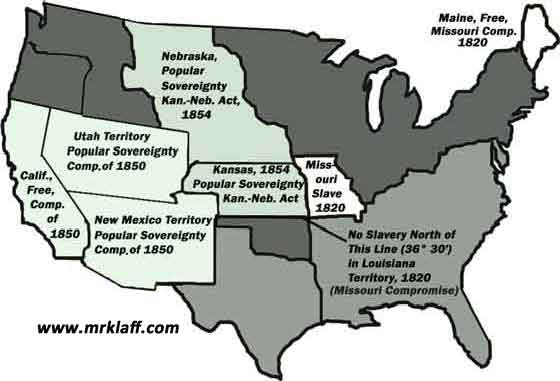
COMPROMISES/font> Constitutional = The Great Compromise (Virginia (bicameral on population) vs. NJ Plan (equal representation), 3/5 Compromise, and Commercial Compromise. Civil War: Missouri Comp, Comp of 1850, K-N Act (KNOW THESE PROVISIONS WELL)
1820 - Missouri is a slave state, no slavery north of 36'30, Maine is a free state. -- Henry Clay.
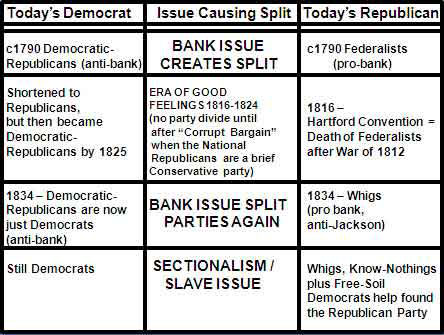
Political Parties Federalist --> Whigs --> Republicans (Free Soilers and Know Nothings unite here) Democrat-Republicans --> National Republicans (era of good feelings) --> Democrats
Women's History Review
CLICK HERE FOR FORMAT OF NEW APUSH TEST TARIFFS TO KNOW 1. 1828 Tariff of Abominations (and Compromise Tariff) 2. Underwood Tariff of 1913 - Democrats regain office and decrease the tariff rates. 3. Hawley Smoot Tariff of 1930 = Raised tariffs to highest point since the Tariff of Abominations. This was done mostly to protect the agriculture industry. D ... DEMOCRATS, TARIFFS GO DOWN, HELP Dee POOR, Deep or Solid South. R ... Republicans, Raise Tariffs, Less Taxes for the Rich, Favor Railroads and Robberbarons. Also comprise the Religious Right. Remember -- when Democrats are in office, tariffs typically go down. When Republicans are in office, tariffs typically go up. Tariffs eased after WWII.
AFL AND KNIGHTS OF LABOR BAGS (Bread Butter Issues /AFL / Gompers / Skilled KUPS (Knights / Unskilled / Powderly / Strike more ... (Unskilled spellers can't spell cups!)
HAMILTON VS JEFFERSON MNEMONIC DEVICE ... SAFE PLANES Jefferson favors State rights and a Strict Interpretation of the Constitution, Agriculture, France, the Educated Commoner SAFE Hamilton = Favors the Propertied or Wealthy, Loose Interpretation of the Constitution, an Army, National Bank, England, and Strong Government PLANES
Nervous about recent stuff on the test? Click below!
Recent Presidents:
Click here for APUSH Flashcards!
Continuity and Change Examples
Presidential Slogans ... TR (Rep) = A Square Deal for Americans! Support consumers over trusts. Woodrow Wilson (Dem) = New Freedom (defeats TR's New Nationalism) and trustbusts with even more tenacity! Warren G. Harding (Rep) = Return to Normalcy post WWI FDR (Dem) = The New Deal - Public Works, and Government Economic influence Truman (Dem) = A Fair Deal - social improvement, and healthcare. Eisenhower (Rep) = Dynamic Conservatism. The 1950s = A conservative time, economically (Gov supports Big Business), politically (McCarthyism), and socially (Women at home, Leave it to Beaver). Eisenhower also signed the Interstate Highway Act to connect the country together with roads. JFK (Dem) = The New Frontier, liberal problem solving for poverty, racial prejudice, and international aid. LBJ (Dem) = The Great Society - Money to the poor, education, and an end to discrimination. THESE WOMEN ARE POPULAR TOPICS! Betty Friedan was a feminist who wrote The Feminine Mystique. She supported equal rights for women, and was the first president of the National Organization for Women (NOW). Phyllis Schlafly was opposed to modern feminism. She was outspoken against the ERA (Equal Rights Amendment).
Mr. Klaff's Time Travel Book for Middle School Readers!
Click here for the AP US History Review Song.
The Presidents Song, by The Social Studs
The Causes of the Civil War Music Video, by the Social Studs
Checks and Balances Song
Click here for the APUS History Review Song!
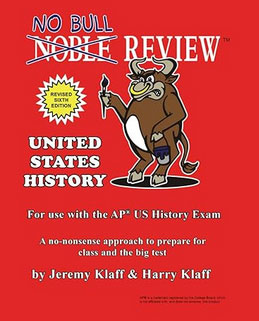
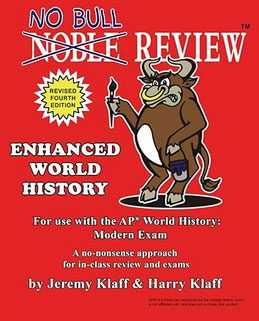
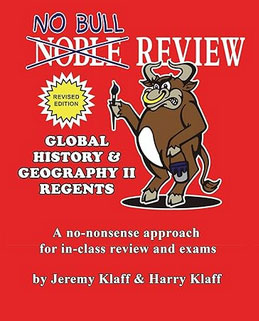
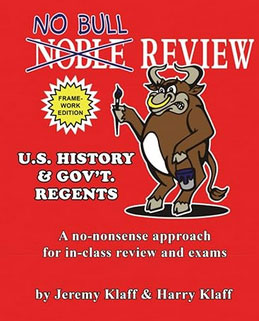
LINKS TO LATEST EDITIONS OF NO BULL REVIEW ...
AP US History AP World History
Global 2 Regents US History Regents
Mr. Klaff's Time Travel Book for Middle School Readers!
Toiletrivia: Bathroom Trivia Books in Print and Kindle
AP ® and SAT Subject TestsTM
are trademarks registered and owned by the College Board, which is
not affiliated with, and does not endorse, this website.
|
|