|
Question:
Which civil rights
leaders should I know about in the 20th Century?
(scroll down for
definition)
Answer:
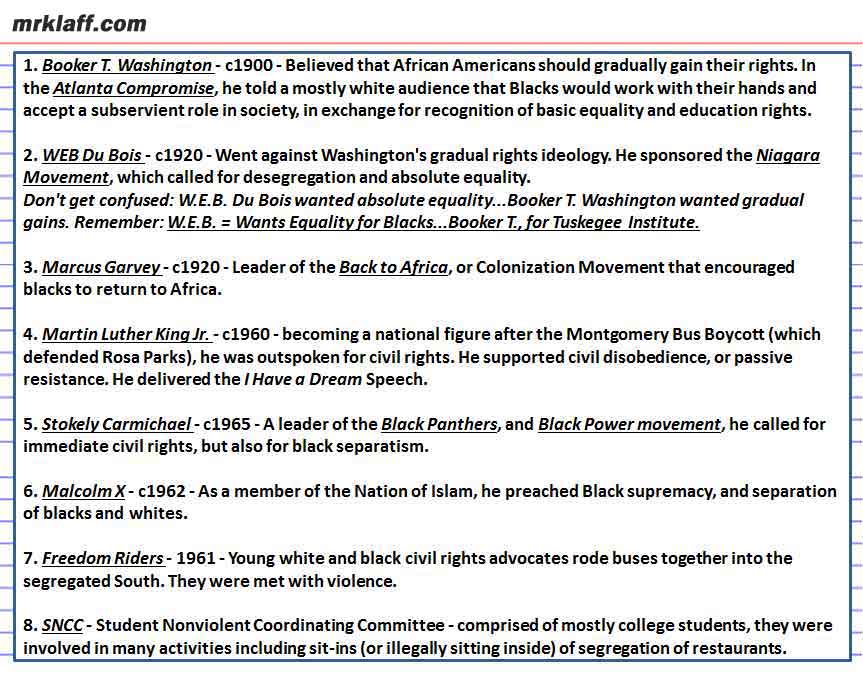
1. Booker T.
Washington - c1900 - Believed that African Americans should
gradually gain their rights. In the
Atlanta Compromise,
he told a mostly white audience that Blacks would work with their
hands and accept a subservient role in society, in exchange for
recognition of basic equality and education rights.
2. WEB Dubois -
c1920 - Went against Washington's gradual rights ideology. He
sponsored the Niagara Movement, which called for desegregation and
absolute equality.
Don't get
confused: W.E.B. Du Bois wanted absolute equality...Booker T.
Washington wanted gradual gains. Remember: W.E.B. =
Wants
Equality
for Blacks...Booker
T.,
for Tuskegee
Institute.
3. Marcus Garvey
- c1920 - Leader of the Back to Africa, or Colonization Movement
that encouraged blacks to return to Africa.
4. Martin Luther
King Jr. - c1960 - becoming a national figure after the Montgomery
Bus Boycott (which defended Rosa Parks), he was outspoken for civil
rights. He supported civil disobedience, or passive resistance. He
delivered the I Have a Dream Speech.
5. Stokely
Carmichael - c1965 - A leader of the
Black Panthers,
and Black Power movement, he called for immediate civil rights, but
also for black separatism.
6. Malcolm X -
c1962 - As a member of the Nation of Islam, he preached Black
supremacy, and separation of blacks and whites.
6. Freedom
Riders - 1961 - Young white and black civil rights advocates rode
buses together into the segregated South. They were met with
violence.
7. SNCC -
Student Noviolent Coordinating Committee - comprised of mostly
college students, they were involved in many activities including
sit-ins
(or illegally sitting inside) of segregation of restaurants.
Click here for next
flash card.
Back to eFlashcard headquarters
|