Definition: Scientific Revolution (scroll down for answer)


Definition: Scientific Revolution c1550-1700

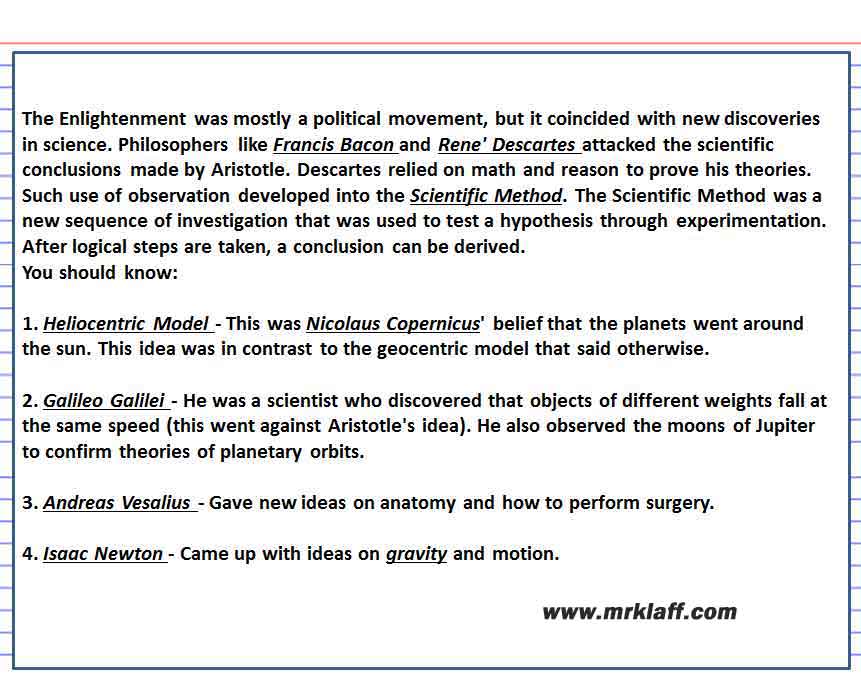
The Enlightenment was mostly a political movement, but it coincided with new discoveries in science. Philosophers like Francis Bacon and Rene' Descartes attacked the scientific conclusions made by Aristotle. Descartes relied on math and reason to prove his theories. Such use of observation developed into the Scientific Method. The Scientific Method was a new sequence of investigation that was used to test a hypothesis through experimentation. After logical steps are taken, a conclusion can be derived.

You should know:

1. Heliocentric Model - This was Nicolaus Copernicus' belief that the planets went around the sun. This idea was in contrast to the geocentric model that said otherwise.

2. Galileo Galilei - He was a scientist who discovered that objects of different weights fall at the same speed (this went against Aristotle's idea). He also observed the moons of Jupiter to confirm theories of planetary orbits.

3. Andreas Vesalius - Gave new ideas on anatomy and how to perform surgery.

4. Isaac Newton - Came up with ideas on gravity and motion.           

Click here for next flash card.      Back to eFlashcard headquarters